Your cost per acquisition (CPA) might look perfectly reasonable. Your ROAS might be solid. And yet your cash position keeps getting tighter every month you scale. If that sounds familiar, the missing piece is usually payback period — one of the least-discussed, most important numbers in DTC acquisition.
What Payback Period Actually Measures
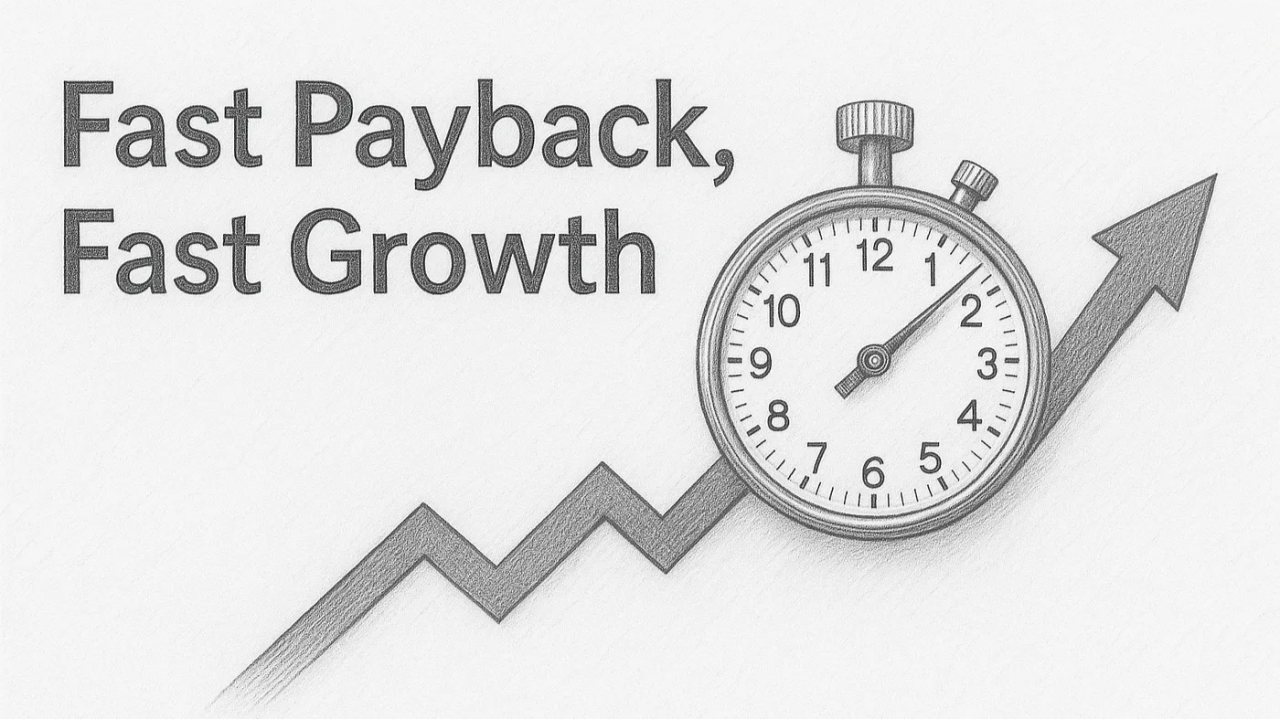
Payback period is the number of days it takes to recover the cost of acquiring a new customer from their purchases. It’s a simple concept with an outsized impact on your business: every day that payback stretches out, you’re spending cash today that you won’t see again for weeks or months.
This matters because CAC and ROAS both describe a single transaction in isolation. Payback period describes cash flow — the thing that actually determines whether you can keep scaling without running into a wall.
Why a “Good” CPA Isn’t Always Good News
Imagine two brands with an identical CPA of £40. One recovers that £40 within 20 days through repeat purchases and a healthy AOV. The other takes 90 days to recover the same amount, because of lower AOV, slower repeat purchase behavior, or higher fulfillment costs eating into the margin.
Same CPA. Completely different financial reality. The first brand can reinvest that capital into acquiring more customers in three weeks. The second is sitting on cash tied up in customers who haven’t paid the business back yet — which limits how aggressively it can scale, no matter how good the CPA number looks in isolation.
The Guardrail Worth Setting
A common financial guardrail is capping new customer payback at 60–90 days. Beyond that window, cash strain starts to compound — you’re committing more capital to acquisition than your business can comfortably absorb before it’s returned.
This is a guardrail, not a hard rule — the right number depends on your margins, your funding position, and how much cash cushion your business can tolerate. But without any guardrail at all, growth can quietly outpace the cash available to fund it.
Why This Gets Missed
Payback period doesn’t show up on most ad platform dashboards. Meta and Google report CPA and ROAS because those are calculable from platform data alone — payback period requires connecting ad spend data to actual repeat-purchase behavior over time, which most standard reporting doesn’t do automatically.
That means it’s entirely possible to be scaling spend, hitting CPA targets, and still slowly working yourself into a cash flow problem — without a single alert telling you it’s happening.
The Fix Isn’t Always “Lower CPA”
Sometimes the fastest way to improve payback period isn’t a lower CPA at all — it’s a stronger retention program that gets new customers to repeat-purchase faster. A lower CAC payback period is often easier to achieve through better email/SMS retention than through squeezing more efficiency out of the ad account alone.
That’s why acquisition and retention shouldn’t be treated as separate problems. They’re two levers on the same number — and payback period is where you can see that most clearly.